Kanji Kaji - 漢字鍛冶
Kanji Kaji 漢字鍛冶
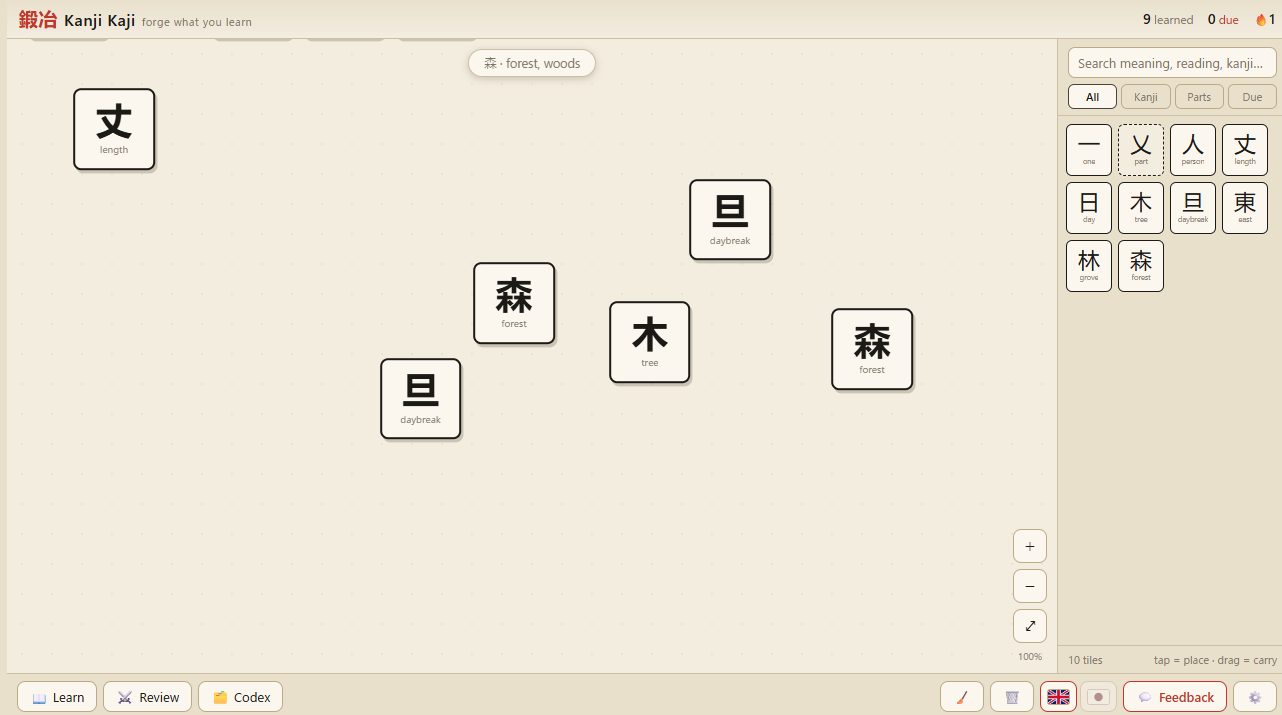
Kanji are built from parts. 木 is a tree. Two of them make 林, a grove. Three make 森, a forest.
In Kanji Kaji you forge kanji by dragging their real components together. Nothing here is invented — every merge is a composition that actually exists, taken from KanjiVG's decomposition data. If the data can't produce an honest split, the character is taught whole instead of faked.
When a kanji comes back for review, you don't flip a flashcard. You forge it again from memory: the parts scatter on the board, you get the meaning and the reading, and you rebuild it.
What's in it
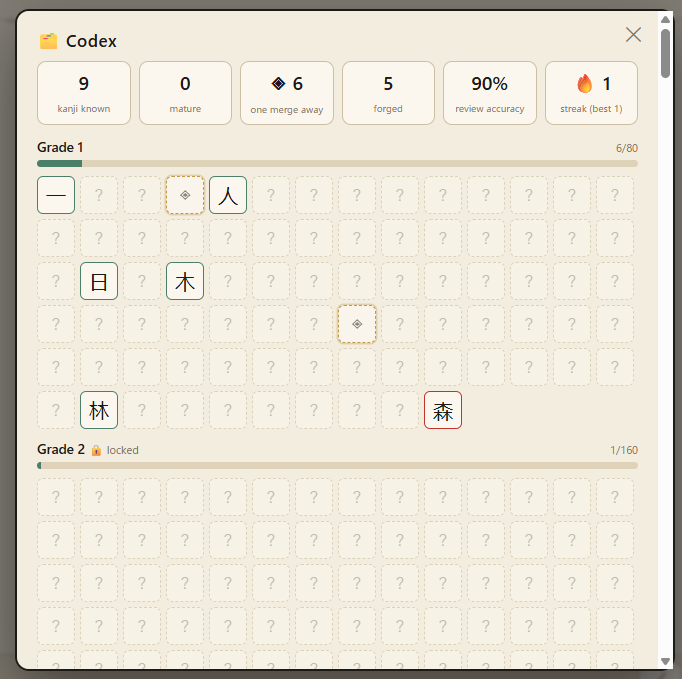
All 2,136 jōyō kanji, grouped by school grade
1,738 merges to discover
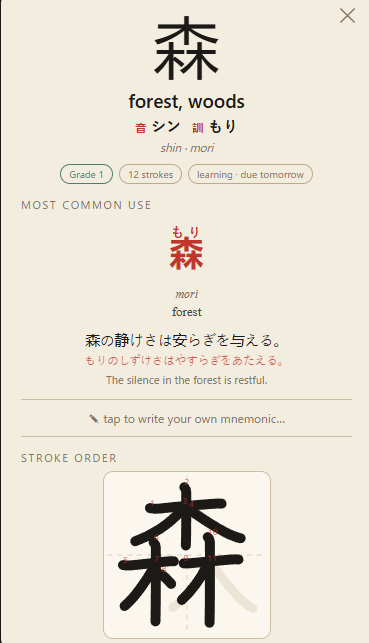
Stroke-order animation drawn from real stroke data
For most kanji, the most common word it appears in, with an example sentence and a full hiragana reading
Spaced repetition, so the shaky ones come back sooner
English or Japanese interface (🇬🇧 / 🇯🇵 in the toolbar)
Free. No account, no ads, nothing to install.
Please read this part
This is a proof of concept. I built it because the idea was fun, not because I've proven it teaches better than anything else. It hasn't been tested at length by real learners, and I'd rather say that up front than promise you results.
The kanji, readings, stroke orders and sentences all come from established open dictionaries, but the choices — which word best represents a kanji, which sentence to show — are made by my own rules, and some of them will be wrong or read unnaturally. Native and advanced speakers: that's exactly what I need to hear about.
There's a 💬 button in the toolbar, and a link on every kanji card. Tell me what's off, in English or 日本語. It takes one tap. If your note improves the game, you go in the credits under the name you choose.
Things to know
Progress is saved in your browser only. Clearing site data will erase it, and it doesn't follow you to another device.
It works on a phone, but it's had far more testing on a desktop browser.
Expect rough edges. If something breaks, the 💬 button takes bug reports too.
Credits & licence
Built on open dictionary data, gratefully: KANJIDIC2, KRADFILE and JMdict — property of the Electronic Dictionary Research and Development Group, used under licence (edrdg.org/edrdg/licence.html). KanjiVG by Ulrich Apel — stroke and component data, CC BY-SA 3.0. Tanaka Corpus (via Tatoeba) — example sentences, CC BY.
The derived data pack is shared under CC BY-SA. Mnemonics are written by you and stay in your browser; none ship with the game.